


Baking Soda: Chemical Reactions (MS)

Teacher Page
Links
This is a required assessment for the Science & Cooking for Educators Program.
No Google Drive resources are available at this time. Questions? Reach out to us.
New to our resources?
This Quick Orientation Guide will help you navigate them easily.
A student-facing page for this lesson is not currently available but will be in the future.
Overview
time:
5
-
10
class periods
standards:
5-PS1-2, 5-PS1-3, 5-PS1-4, MS-PS1-1, MS-PS-2, MS-PS1-5
science concepts:
chemical reactions, conservation of matter, chemical changes
Summary
Explore what makes baking soda “work” and what happens when it works through a series of investigations and a simple kefir flatbread or pancake recipe.
This lesson was recently updated.
Update Date:
December 2025
Summary of Updates
Version 4 (V4) Updates (as of December 2025)
● New Gas Interactive to help students understand density (Lesson 1.5)
● New Lesson: Additional Chemical Reactions (after Lesson 1.6)
● Switch order of lessons 1.4 and 1.5
● Highlight multiple areas for formative assessment throughout storyline (for grading/evaluation)
● Modifications to assessment (clarity and statements to show alignment to NGSS)
● Added substantial detail to help facilitation of initial model of fluffy pancake in Lesson 1.2 and returning to consensus model in last lesson (Lesson 1.8)
Version 4 (V4) Updates (as of December 2025)
● New Gas Interactive to help students understand density (Lesson 1.5)
● New Lesson: Additional Chemical Reactions (after Lesson 1.6)- Includes…
● Interactive with Video
● Easy Hands-On Investigation (not food-related)
● Switch lessons 1.4 and 1.5→ Students identify the gas before completing the Lab: Bubbles in a Bag so we can build a more complex initial model and go into chemical formulas
● Modifications to assessment (Google Form) (improved clarity of wording in questions and included substantially more detail in teacher notes about how each question aligned to NGSS and its purpose).
● Added substantial detail to help facilitation of initial model of fluffy pancake in Lesson 1.2 and returning to consensus model in last lesson (Lesson 1.8)
Version 3 (V3) Updates (as of June 2025)
New Activities:
● Lesson 1.1- initial model
- Optional muffin lab to use in place of pancake lab (Lesson 1.1)
● Lesson 1.2- new Investigation 1 [Video]: Did heat produce gas? If students think gas production is due to heat, this rules this out.
● New Lesson (Lesson 1.5 What is the gas?): Students do gas tests and learn about different gases and how to distinguish them using properties like flammability and density; provides opportunity to go over simple molecules and chemical formulas
Modifications:
● Reordered lesson sequence heavily; many activities are the same but in slightly different order (e.g. Pancake lab is now in Lesson 1.1 and What activates baking soda is in Lesson 1.3)
● More scaffold modeling for Bubbles in a Bag Lab (Lesson 1.4)
Classroom Slides & Student Handouts
Guidelines for Adapting Worksheets or Slides:
-
Attribution: If you adapted a worksheet, add "Adapted from" to the @bitescizededucation on the footer.
-
Slides: If you change the style of the slides, keep the Bite Scized Education logo in the top corner or add to all slides "adapted from @bitescizededucation" at the bottom.
-
-
Logos: Please keep our logos on all documents.
-
Sharing: These resources should not be shared with teachers who have not purchased these lessons or participated in our professional development sessions. If you have an interested colleague, reach out to us @bitescizededucation@gmail.com.
-
Support: If you have any issues accessing the folder, please reach out to us at bitescizededucation@gmail.com for assistance.


Simulations for this Lesson
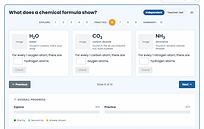
Acids Exploration (Preview)

Tea and Temperature

Modeling Smell

How is Tea Made?
Simulations are available when lessons are purchased in units or longer sequences.
You must be logged in to access these simulations. Create a general student account for students to access simulations and resources here.
New Lesson Plan Format Available!
We've moved away from the long scrolling doc! The new format is designed to be easier to navigate—key info stays accessible but out of your way until you need it.
What's new:
-
Toggle sections open/close so you see the big picture first, details when you need them
-
Easily jump around from lesson to lesson
-
Filter activities by type to plan your week at a glance
-
Unit overview and NGSS alignment tucked away, but just a click away
- Consolidated shopping list for easier planning and easier navigation to lab prep information
Exit out of this box to stick with the old format.
No additional documents are available at this time.
If you believe this is an error, reach out to us.
If you're experiencing difficulties with a document uploading, try switching to a different tab and then returning the tab or refreshing the page.